






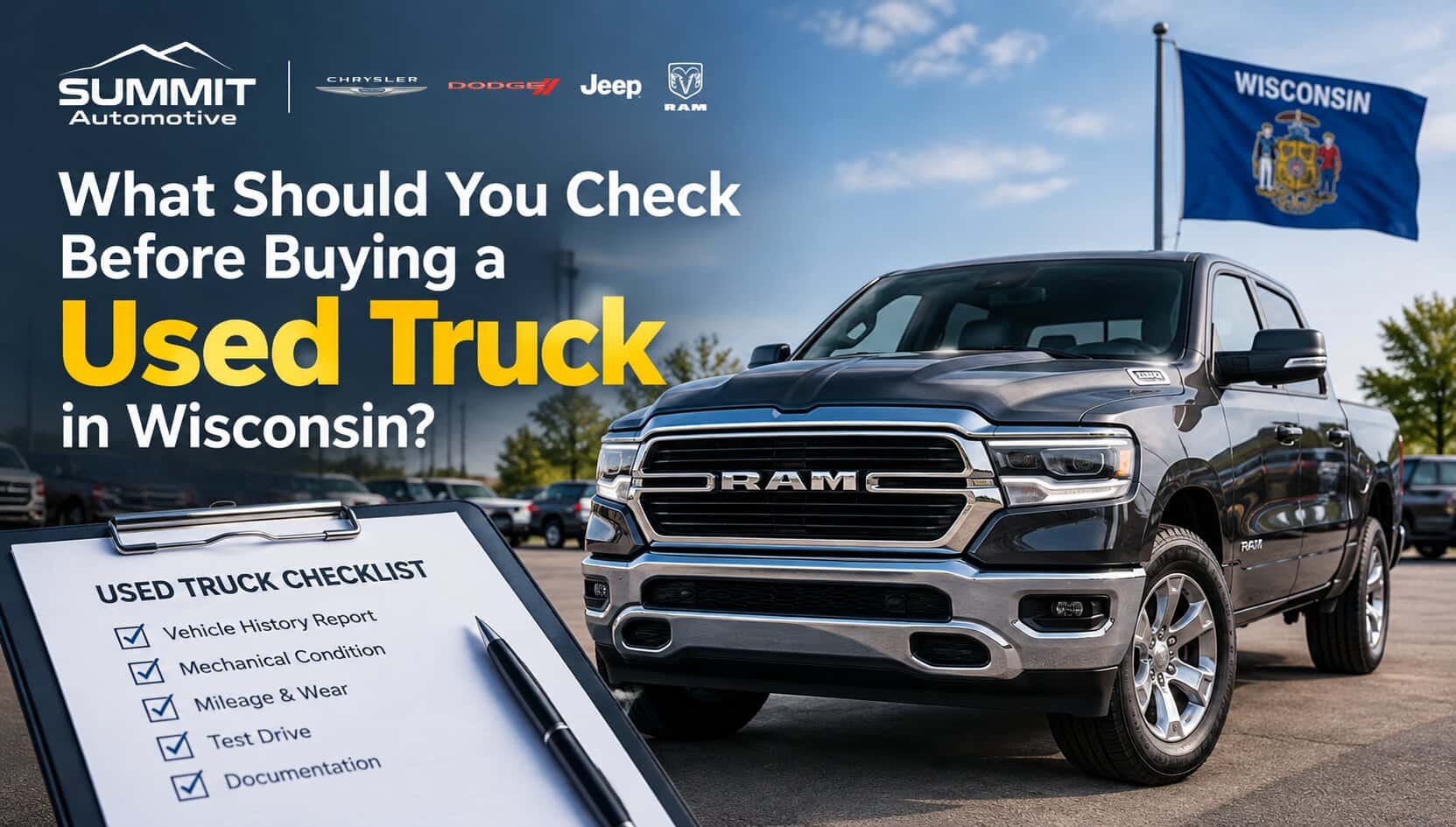
What Should You Check Before Buying a Used Truck in Wisconsin?
A used truck that looks great in a photo can tell a very different story once it is up on a lift. That gap matters more here than it does in most of the country, because a truck that has spent its winters on salted Wisconsin roads ages differently than the same truck from Texas or Arizona.
If you are shopping in Fond du Lac, the Fox Valley, Dodge County or anywhere in between, here is what actually deserves your attention before you sign anything.
1. Start underneath, not under the hood
Rust is the single biggest reason a used truck in Wisconsin turns from a good deal into a money pit. Engines and transmissions can be rebuilt. A rotted frame usually ends the conversation.
Bring a flashlight and get low. Look at:
- Frame rails, especially near the rear leaf spring hangers and shackles where salt and moisture collect
- Brake and fuel lines that run the length of the frame. Flaking, scaly lines are a safety problem and a common failure point on trucks in their second decade
- Rocker panels and cab corners, where bubbling paint usually means the rot started on the inside and worked outward
- Bed sides above the rear wheel arches and the bottom seam of the tailgate
- Cab and body mounts, plus the rear crossmember and hitch area
- The bed floor underneath a drop-in liner. Plastic drop-in liners trap salt, sand and water against the metal, so the worst rust on the whole truck is often hidden right there
Learn the difference between surface rust and structural rust. Light orange dust that wipes off is normal on any Midwest truck and is not a dealbreaker. Thick scale that flakes away in layers, or metal that flexes or crunches under light pressure, is a different category entirely.
2. Figure out how the truck actually spent its life
Two trucks with identical mileage can be in completely different condition depending on what they did. In this part of the state, most used trucks fall into a handful of categories, and each leaves evidence.
Plow trucks. Look for plow mount brackets or empty bolt holes on the frame horns, extra wiring under the hood, unexplained switches in the cab, or a front end that sits lower than the rear. Plowing is hard on front suspension, transmissions and charging systems. A well maintained plow truck can still be a good buy, but it needs a closer look at the front end and transmission than a commuter truck does.
Farm trucks. Gravel and field roads chip paint, sandblast the underside and beat up suspension bushings. Mileage is often lower than you would expect, but hours of hard use are higher.
Tow rigs. Check the hitch for wear and scoring, look for a factory or aftermarket trailer brake controller, inspect the seven pin connector for green corrosion, and see whether the rear suspension sags or has added airbags and helper springs. Pull the transmission dipstick if the truck has one. Dark fluid with a burnt smell on a truck that towed heavy is worth asking about.
Fleet and work trucks. Often well maintained on a schedule, often hard driven, and frequently loaded with ladder rack or toolbox mounting holes in the bed rails.
None of these histories automatically disqualify a truck. You just want to price and inspect accordingly.
3. Test the four wheel drive system before you need it
Plenty of used truck buyers discover a bad transfer case actuator during the first real snow in December. Do not be that person.
On a safe, loose surface, engage four wheel high at low speed and drive straight for a bit. Then try four low. You want clean engagement, no grinding, no dash light that blinks and never solidifies, and no binding or shuddering during slow, tight turns. Listen for clunks from the front differential and hubs. If the seller or salesperson is reluctant to let you test it, that tells you something.
4. Check the things that only matter when it is cold
Wisconsin trucks get judged in January, not August. Before you buy:
- Ask for a true cold start. The first start of the day tells you far more than a start on an engine that has been idling in the lot. Listen for extended cranking, rough idle or visible smoke
- Inspect the battery and terminals. Note the date code and look for corrosion or a loose ground
- On a diesel, find the block heater cord and confirm it is intact and the plug is not damaged. Watch the wait to start light and listen for glow plug behavior
- Run the heat and defrost through every setting. Weak heat can mean a failing thermostat, a clogged heater core or a broken blend door
- Test heated seats, heated mirrors, rear defrost and remote start if the truck has them
- Look at the tires. Check tread depth, whether all four match, and the date codes on the sidewall. Old tires with plenty of tread are still old tires, and they harden up in the cold
5. Match the truck to what you will actually pull
Buyers routinely overbuy or underbuy here. A half ton handles a bass boat, a small camper and yard duty comfortably. If you are pulling a loaded car trailer, a large travel trailer or livestock, a three quarter ton or one ton with the right axle ratio and towing package is the honest answer.
Get the specific numbers for the specific truck, not the brochure maximum for the model line. Payload and tow ratings change with cab configuration, bed length, engine, axle ratio and drivetrain. The payload sticker on the driver’s door jamb is the real number for that vehicle.
6. Take a real test drive
A loop around the block proves nothing. Try to cover:
- Rough pavement or gravel to hear worn bushings, sway bar links and shocks
- Highway speed to feel for vibration, pulling, driveline shudder and whether the transmission locks up smoothly
- Firm braking in a safe, empty area to check for pulsing or pulling
- Full lock turns in a parking lot to listen for clicking from the front end
- An incline if you can find one, to see how the transmission behaves under load
Turn the radio off for all of it.
7. Understand the Wisconsin paperwork
This is where local knowledge saves you real money, and where buying from a licensed dealer gives you protection a private sale does not.
The Wisconsin Buyers Guide. Licensed Wisconsin dealers are required to display a completed Buyers Guide on used vehicles offered for sale, and to show it to you before a purchase offer is drafted. It discloses prior use, title brands, significant known defects, evidence of structural or frame repair, and warranty status. Read it, and take your copy with you.
“As Is” does not mean “no disclosure.” In Wisconsin, an as is sale means the dealer is not paying for repairs that come up after the sale. It does not relieve them of the duty to disclose known defects they could reasonably have found. That is a meaningful difference from a private party sale where you have essentially no recourse.
Title brands. Watch for rebuilt salvage, flood or water damage, and manufacturer buyback notations. Flood trucks in particular tend to migrate north after storms in the South, get cleaned up and reappear on the market with fresh carpet and a suspiciously clean interior.
Emissions testing. Wisconsin only requires emissions testing for vehicles customarily kept in seven southeastern counties: Kenosha, Milwaukee, Ozaukee, Racine, Sheboygan, Washington and Waukesha. Fond du Lac County is not one of them. If you live in one of those seven, a vehicle more than five model years old generally needs a test at change of ownership.
No state safety inspection. Wisconsin does not require safety inspections for passenger vehicles. Nobody from the state is checking that truck’s brake lines for you. That responsibility sits with you and with the dealer you choose.
Title and plate processing. State law requires Wisconsin dealers to submit your title and plate application to WisDOT, electronically or by mail, within seven business days of the transaction.
8. Get an independent inspection if anything feels off
A pre purchase inspection on a lift is inexpensive relative to what it can catch. Any seller who resists putting a truck on a lift has told you what you need to know.
If you are buying from a dealer with a service department, ask what reconditioning was done, whether it was inspected, and what was repaired or replaced. A dealership that stands behind its used inventory will answer that question in detail.
Quick checklist to bring with you
- Frame rails, brake lines, fuel lines and crossmembers
- Rocker panels, cab corners, bed sides, tailgate seam
- Under the drop-in bedliner
- Plow mount holes, extra wiring, front end sag
- Hitch wear, brake controller, seven pin connector corrosion
- Four high and four low engagement
- Cold start, battery, block heater, heat and defrost
- Tire tread, matching set, sidewall date codes
- Payload sticker on the door jamb
- Wisconsin Buyers Guide and title brands
- Service records and reconditioning notes
Frequently asked questions
What is the most important thing to check on a used truck in Wisconsin? Rust, specifically frame and brake line condition. Surface rust is normal on any Midwest truck. Scaling, flaking or perforated metal on the frame, brake lines or cab mounts is a serious problem and is usually more expensive to fix than it is worth.
Does Wisconsin require a safety inspection before I buy a used truck? No. Wisconsin does not require safety inspections for passenger vehicles, which is exactly why a careful personal inspection or an independent pre purchase inspection matters so much here.
Do I need an emissions test for a used truck in Fond du Lac County? No. Emissions testing applies only to vehicles customarily kept in Kenosha, Milwaukee, Ozaukee, Racine, Sheboygan, Washington or Waukesha counties. Fond du Lac County is outside the program.
Should I avoid a truck that was used for plowing? Not automatically. Plowing is hard on the front suspension, transmission and charging system, so a plow truck needs a closer inspection and should be priced with that history in mind. A well maintained one can still be a solid buy.
Is a rust free truck from the South a better choice? Sometimes, and it is worth considering. Just verify the title is clean, check carefully for flood damage, and remember that it will start accumulating salt exposure the first winter it spends here. Ask about undercoating or rustproofing.
How many miles is too many on a used truck? Condition and maintenance history matter more than the odometer. A well documented higher mileage truck that was maintained on schedule is often a better buy than a low mileage truck with no records and a rotted underside.
Shopping for a used truck in the Fond du Lac area?
Summit Automotive Chrysler Dodge Jeep RAM keeps a rotating selection of used trucks on the lot, including RAM 1500, 2500 and 3500 models along with trade-ins from other brands. Every truck goes through our service department before it hits the front line, and our team will walk you around the vehicle, put it on a lift if you want a closer look, and answer the questions on this list without dodging.
Summit Automotive Chrysler Dodge Jeep RAM 815 S Rolling Meadows Dr, Fond du Lac, WI 54937 920-921-0850
Browse our used truck inventory or schedule a test drive and come see one in person.

0 comment(s) so far on What Should You Check Before Buying a Used Truck in Wisconsin?